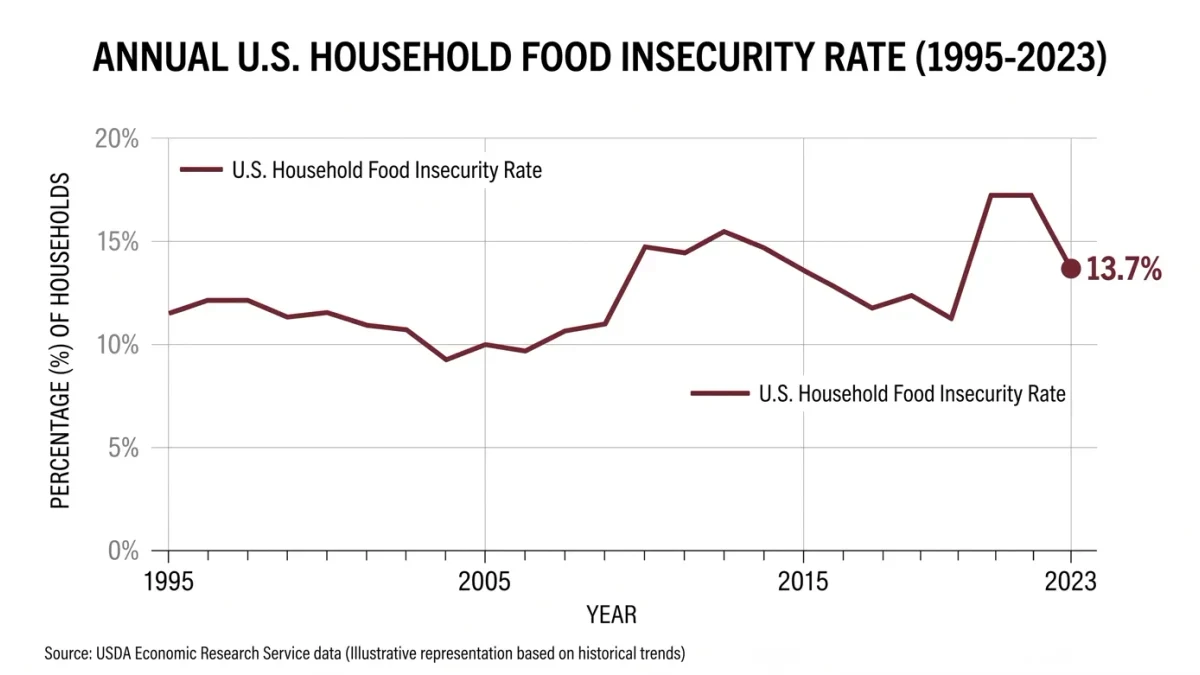
The U.S. Department of Agriculture published, on October 22, 2025, the final edition of its annual food-security report, and the number in it was 13.7 percent: 18.3 million American households, roughly one in seven, experienced food insecurity at some point during 2024. The same document is now a series finale. On September 20, 2025, the department announced it was terminating the Food Security Supplement to the Current Population Survey, calling the survey redundant, ending an unbroken measurement that began in 1995.
What did the final report document?
The findings of Household Food Security in the United States in 2024 were broadly consistent with the plateau the survey had recorded since the pandemic-era spike. Food insecurity, defined as reduced quality or variety of diet with uncertainty about resupply at the low end and disrupted eating patterns at the severe end, remained concentrated in households with children, single-mother households, Black and Hispanic households, and households below the poverty line. The Food Research and Action Center, translating households into people, put the count at 47.9 million Americans living in food-insecure households during the year.
Because the measure is annual and survey-based, it functioned as the country's only nationally representative yardstick of hunger, used by Congress for program design, by states for waivers, and by the charitable food network, from food banks to school-meal advocates, to direct resources. Feeding America's Map the Meal Gap, which estimates county-level need, separately projected a 14.4 percent rate for 2024, slightly above the official figure.
Why did USDA end the survey?
In its September 20, 2025 press release, the department described the survey as redundant with other federal data collection. Researchers have pushed back with specifics: no other instrument produces the validated 30-day and 12-month food-security scales, and alternatives like the Census Household Pulse or dietary-intake surveys measure different things on different bases. The Columbia Poverty Center has already published methodology for predicting national rates in the absence of official collection, and policy groups including AEI and Children's HealthWatch, which rarely agree on much, have separately documented the loss of a consistent, nationally representative series.
The termination is part of a broader contraction of federal statistical capacity documented through 2025, and it lands on programs with budgets in the tens of billions. SNAP, WIC, and school-meal funding formulas and evaluations leaned on the series; without it, the next farm-bill debate will argue about hunger using estimates rather than measurements.
What replaces the official number?
A patchwork, for now. Academic centers are extending the series with modeled projections. Private networks publish their own counts of meals distributed, which track demand but not population rates. And state-level surveys, where they exist, are inconsistent across borders. The documented risk is familiar to anyone who has watched local-news deserts: when nobody measures a problem on a fixed schedule, the problem becomes easier to budget against and harder to litigate.
What does this mean for workers and communities?
Food insecurity is primarily a working phenomenon: the survey's own history shows most food-insecure households contain at least one working adult, and USDA has documented that the problem spikes where wages are low and volatile. Employers in retail, food service, warehousing, and care work have long carried, often unknowingly, the productivity and turnover costs associated with it, which is why several large employers have partnered with food banks in documented workplace programs. Without the annual number, those local efforts lose their federal baseline.
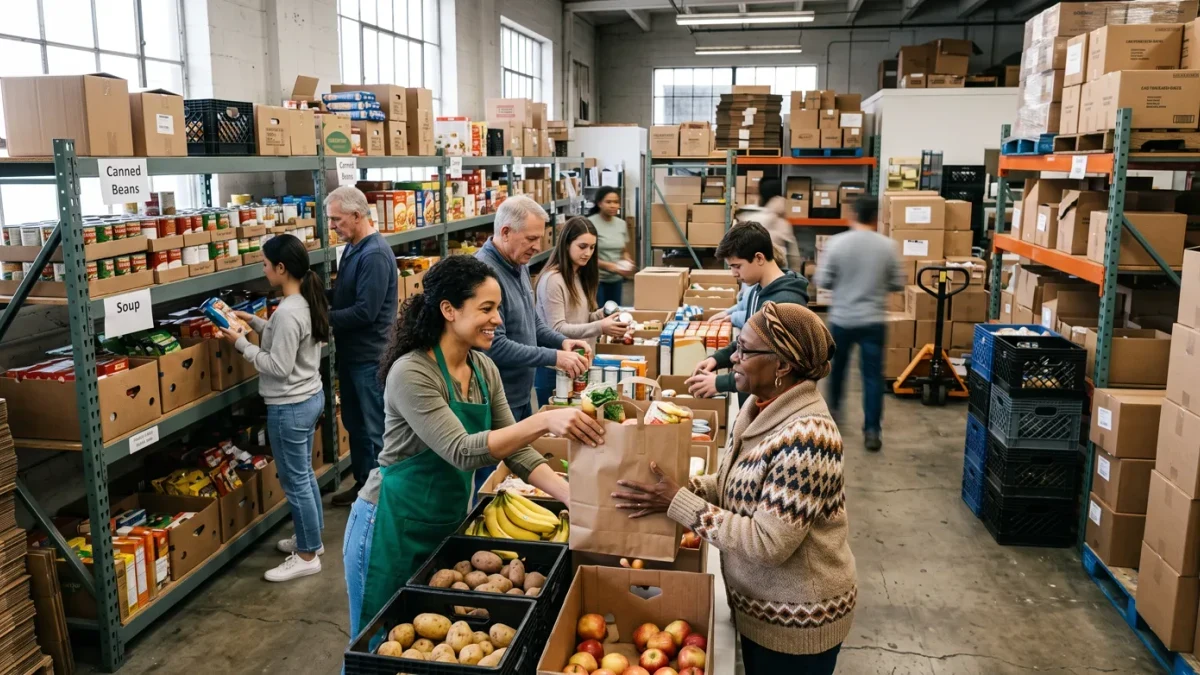
For communities, the measurement gap arrives as demand on food banks has run above pre-pandemic levels, a trend the charitable sector has documented in distribution data through 2025. The last official reading, in other words, is not a portrait of a solved problem but of a stuck one, and it is now also a portrait the government will not update.