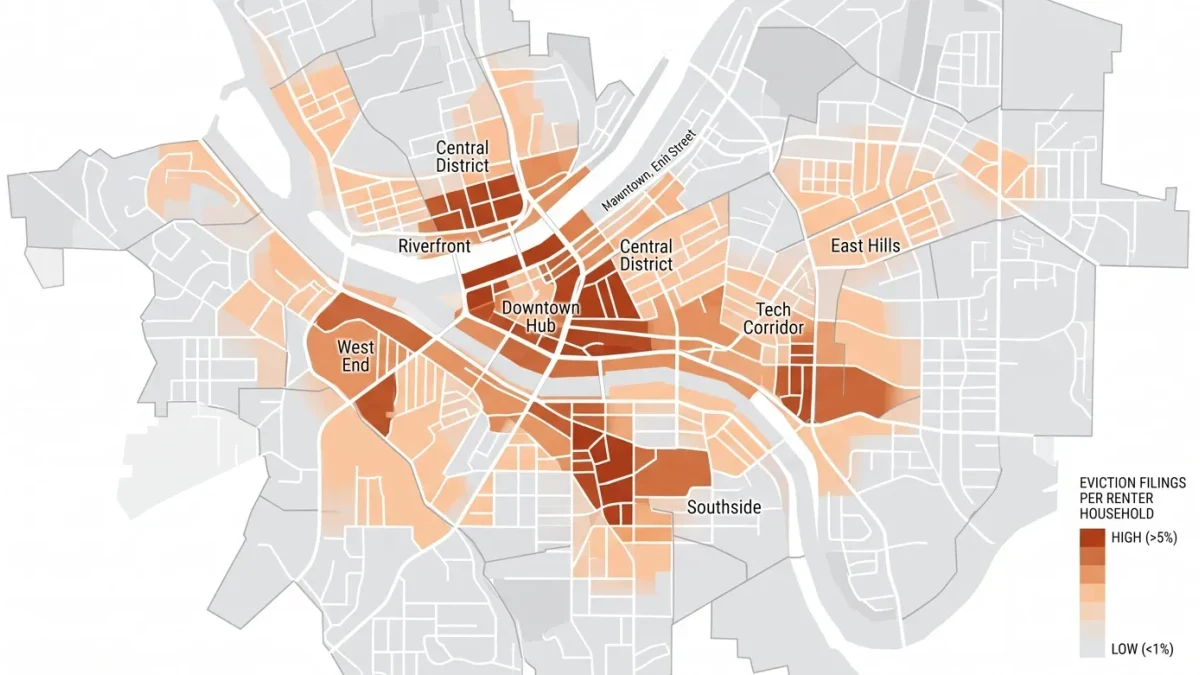
The United States does not publish a national eviction statistic, so researchers built one. By collecting court records directly, initiatives at Princeton University and regional legal-aid data projects assembled the first reliable time series of eviction filings, and the documented scale surprised even housing scholars: filings have run above pre-pandemic norms in recent years, totaling in the millions annually across the covered jurisdictions, with the deepest concentrations in Sunbelt metros and Black and Hispanic neighborhoods, where filing rates run multiples of the regional average.
What the filing data actually measures
An eviction filing is a lawsuit, not a lockout. Most filings end in payment agreements or default judgments rather than sheriff-enforced removal, but the record itself is the damage: tenant-screening databases ingest filings for years afterward, so a filed case functions as a credit event that follows renters across apartments and cities. The Princeton Eviction Lab's national database, built from tens of millions of records, documented that filings cluster geographically at the block level, in the poor neighborhoods adjacent to the boom districts, and serially, with a minority of landlords responsible for a large share of filings, and a minority of properties, large corporate-owned complexes, overrepresented relative to small owners.
What drove filings up after the moratorium?
The pandemic era compressed a natural experiment. The CDC moratorium, the Emergency Rental Assistance program, and state court closures pushed filings to record lows in 2020-2021; the documented rebound after programs expired was steep, and by 2023-2025 covered jurisdictions were running at or above pre-pandemic baselines. The structural driver is rent burden, which the Census's Housing and Vacancy data and Harvard's Joint Center for Housing Studies documented at historic highs: roughly half of renters paying more than 30 percent of income for housing, and over a quarter paying more than half. At that margin, any income shock, a car repair, a shift cut, a medical bill, converts directly into a filing.
What policies does the data test?
The record now grades several interventions. Right-to-counsel laws, which guarantee tenants lawyers in eviction court, documented large reductions in executed judgments and high rates of negotiated stays in New York, Cleveland, and other early adopters, exploiting the documented asymmetry that most landlords appear with counsel and most tenants do not. Eviction-diversion programs, mediation plus rental assistance before judgment, documented filing reductions where administered well. Sealing laws, which restrict screening databases' access to dismissed or non-judgment cases, target the record-blight problem directly, with early adopters including California and New York documenting mixed implementation, since data brokers ingest filings faster than courts seal them. And rent stabilization debates cite the filing data on both sides, with landlord groups documenting small-owner exits and tenant groups documenting the serial-filer concentration.
What does eviction do to work and school?
The downstream record is the part employers and principals see. Studies following displaced households document elevated job loss, the disruption that follows an involuntary move, unstable transportation, childcare upheaval, address gaps, hits employment within months, and school changes for children that track with documented attendance and achievement declines. Housing instability is thus a labor-market variable hiding in HR turnover statistics, which several large employers in warehousing and retail have acknowledged indirectly through emergency-assistance partnerships, documenting employee requests dominated by rent shortfalls.
How to read your city's numbers
Use the court-record trackers, not anecdotes, and read three cuts: filings per renter household by neighborhood, the share of filings by the largest filing plaintiffs, and the judgment-versus-dismissal split, which measures whether the court functions as a collections mechanism or a negotiation venue. The debate the data rewrote is simple to state: eviction in America is not mainly a failure to pay caused by misbehavior, it is a rent-arithmetic event concentrated by geography and ownership, and the record now exists, block by block, to argue it with numbers.