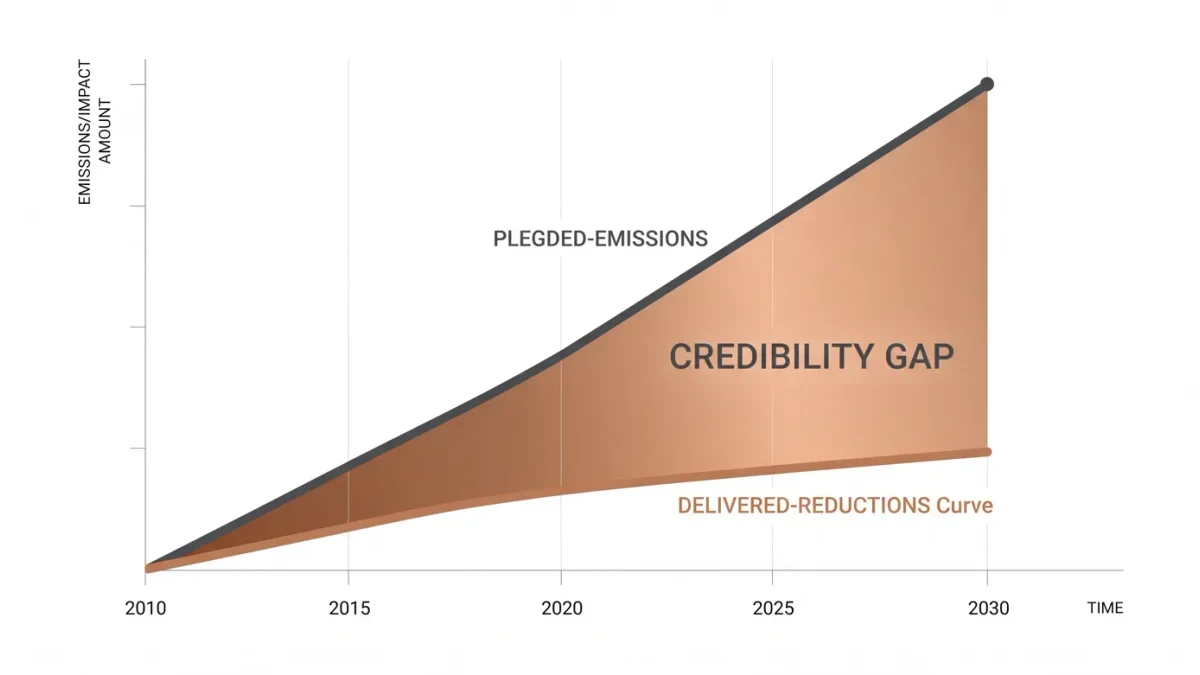
The decade's corporate climate pledges are entering their due dates, and the accounting has begun in earnest. By the mid-2020s, thousands of companies had pledged net-zero or science-based targets through initiatives like the Science Based Targets initiative, whose validated companies represent a large share of global market capitalization. But the annual scorecards that now grade delivery, from Climate Action Tracker's corporate counterparts to academic audits of net-zero commitments, document the same pattern: most large emitters are not on track for the 2030 milestones they set, and a meaningful share of the pledges quietly disappeared from corporate websites when attention moved on.
How are the pledges actually scored?
The methodology matters, because it determines what counts as delivery. Serious scorecards measure absolute emissions against base years, typically 2015 through 2020, using company-reported scope-one and scope-two data. The softer accounting, which companies prefer in sustainability reports, counts intensity, emissions per unit of output, and carbon offsets, whose scientific credibility has been repeatedly challenged in academic reviews of forestry and avoidance-credit projects. The documented gap between the two accountings is now the central fight in corporate climate reporting: a company can report intensity progress while absolute emissions rise, and offset-heavy net-zero plans can claim neutrality while the smokestacks run unchanged.
What does the delivery record show?
The record sorts companies into three documented groups. A minority, concentrated in power, technology, and consumer goods, are genuinely cutting: utilities that retired coal on schedule have delivered the largest verified absolute reductions, since electricity decarbonization is infrastructure-heavy but well understood. A middle group has plateaued, reporting efficiency gains that growth consumes. And a large group of the original pledgers missed, delayed, or dropped targets, with the nonprofit Climate Integrity and academic researchers documenting net-zero commitments removed from websites years after splashy announcements.
The oil-and-gas sector deserves separate billing, because its pledges are structurally different: company transition plans rest heavily on selling fossil assets to other owners, which changes nothing in the atmosphere, and on future technologies, carbon capture, hydrogen, biofuels, that remain small relative to core production. Reuters and Bloomberg have documented individual supermajors softening or dropping 2030 targets as the political winds shifted in 2024 and 2025.
What changed after the politics turned?
The anti-ESG backlash and the SEC's withdrawal from climate-disclosure litigation in 2025 gave companies cover to go quiet, and the documented result is bifurcation rather than retreat. Companies whose climate plans were commercially driven, cheap renewable power, customer supply-chain requirements, European regulation, kept executing without the vocabulary. Companies whose plans were reputational, conference-stage commitments backed by no capital plan, were the ones that evaporated. The useful test, validated by the scorecards, is whether the pledge was ever attached to capital expenditure: where boards allocated money, delivery followed; where the pledge lived in the sustainability office, it did not survive the rebranding.
What is at stake for workers and communities?
Pledge accounting is not abstract in the places emissions come from. Coal retirements, the largest verified corporate emission cuts of the decade, closed plants and ended payroll in communities that powered the country for a century, and the transition assistance that arrived, documented in federal energy-community funding, has been criticized both as too small and as too slow to disburse. The battery and EV investments meant to replace that work concentrated in different states. Climate scorecards grade companies; communities keep a different ledger, of tax base, school enrollment, and whether the new plant's hiring ever matches the old plant's payroll.
What should a reader watch?
Watch the 2030 milestones against base-year data, in absolute terms, without offsets. Watch whether boards keep the capital expenditure attached to the target when the politics are hostile, because that is the documented difference between delivery and decoration. And treat any net-zero pledge that lacks an interim number, a base year, and a capital plan as what the record says it usually is: a press release with a long fuse.