Every wave of automation arrives with a promise attached, and the AI wave's version is the retraining pledge: billions announced by the largest technology companies, and billions more by governments, to skill the workers whose jobs the tools will transform. The pledges date to the last wave's rhetoric, the 2018 Pledge to America's Workers, thousands of companies committing to enhanced career training, through the 2020s AI-era announcements, and they now have a delivery record that can be read.
What was promised, and what arrived?
The documented pattern repeats across companies and programs. The headline numbers count existing spending, internal training programs, tuition benefits, certification courses, that predate the pledge, a repackaging effect accountability reporting documented in the federal pledge's own tallies. What arrived as new money concentrated in free and low-cost online coursework, the platforms' own academies and certificates, whose enrollment numbers are real, millions of learners, and whose completion and employment outcomes the platform research documents as thin: completion rates for self-paced online coursework run in the single digits, and hiring studies show certificates helping most for workers who already hold degrees, the documented add-on rather than on-ramp pattern.
What does the research say about who benefits?
The labor-market literature on AI and skill change, including the task-exposure work of economists tracking which jobs absorb AI tools, documents a consistent gradient: the workers most exposed to AI-driven task change, clerical, customer service, entry-level analytical, are the least served by the retraining infrastructure as built, which is self-paced, online, and English-and-credential friendly. The workers documented benefiting most already have degrees, credentials, and employers who sponsor learning time. Training targeted and sponsored by employers, the apprenticeship and earn-while-you-learn models this series has covered, documents the strongest outcomes; training left to the worker's evenings documents the weakest. The gap is not motivation, the completion data says; it is time, pay, and support.
Why did the pledges underdeliver?
Three documented reasons. Incentive misalignment: retraining the displaced of other firms and industries is a public good, not a corporate one, and the pledges were written for the announcement, not the payroll. Measurement evasion: pledges denominated in opportunities, offered, rather than outcomes, achieved, cannot be audited, and the accountability groups that tried documented the definitional fog. And the honest hard problem: retraining at scale has never worked well anywhere it was tried quickly, a finding from the trade-shock programs, the federal Trade Adjustment Assistance evaluations, that preceded AI: retraining works when it is local, employer-connected, and patient, and fails when it is national, online, and fast.
What works, on the record?
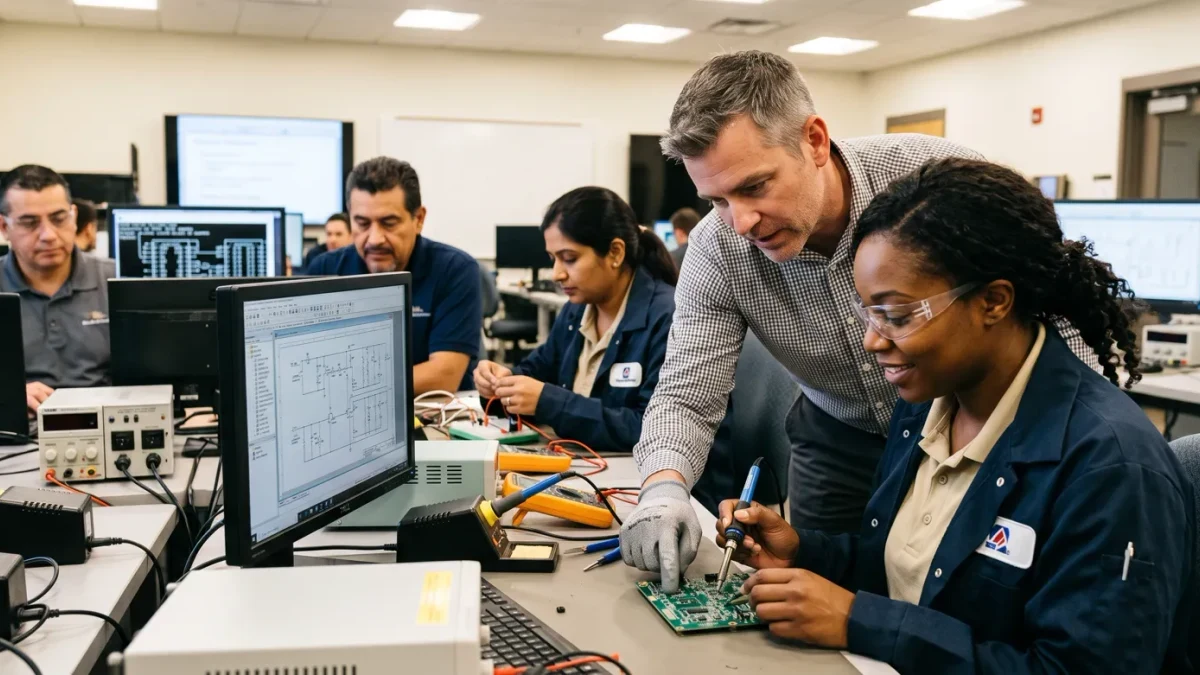
The documented winners share design features: employer partnership with hiring commitments, community-college and intermediary delivery with wraparound support, stackable credentials tied to occupation ladders, and paid training time, the apprenticeship formula applied to new sectors. The strongest AI-era examples are in-house: companies retraining their own workforces, customer service to AI-oversight roles, junior analysts to tool-auditing, documented in case studies, precisely because the incentive and the learner's day job are aligned. The public infrastructure, workforce boards and community colleges retooled around AI curricula, is documented as chronically underfunded relative to the pledged corporate billions, an asymmetry the field's own assessments note.
What should workers and policymakers expect?
Workers: the credible ladder runs through an employer or an intermediary with employers attached, and the standalone free course, however excellent, documents completion and hiring rates that make it a supplement, not a plan. Policymakers: convert pledges into auditable numbers, completions and placements, not enrollments, and fund the delivery system, colleges, boards, intermediaries, that actually moves people, rather than applauding platform generosity. The AI transformation is real, the pledges were real, and the record, as ever in this series, is the boring part: promises are measured in press releases, and skills are measured in paychecks, and the exchange rate between the two is what the next decade of this coverage will count.