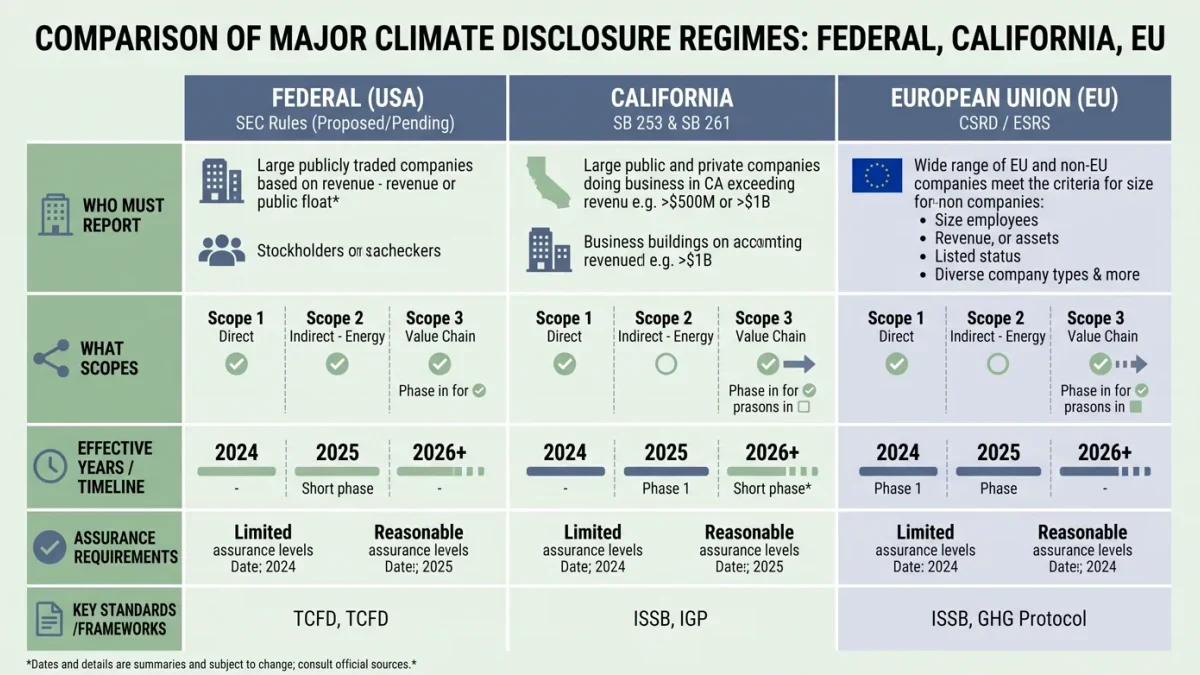
The federal government stopped defending its climate-disclosure rule in March 2025, when the Securities and Exchange Commission voted to withdraw from litigation over the standard it had adopted just a year earlier. But the reporting season that began on January 1, 2026 shows the retreat did not end the paperwork: California statutes, European rules, and insurer pressure now require thousands of American companies to publish essentially the same data anyway.
What happened to the SEC rule?
The commission adopted its climate-disclosure rule in March 2024 after a decade of drafts, requiring large public companies to report material climate risks and, for the largest firms, certain emissions information. Legal challenges from industry and states consolidated in the Eighth Circuit immediately stayed the rule. In March 2025, under new leadership, the SEC voted to withdraw its defense, and the rule has remained inoperative since, a fate reported by Reuters and Bloomberg as an effective repeal without formally being one.
What do California's laws require in 2026?
Two California bills signed in October 2023 took the federal government's place. SB 261, the climate-related financial risk act, required companies doing business in California with revenue above $500 million to publish climate-risk reports by January 1, 2026. SB 253, the emissions disclosure act, requires companies above $1 billion in revenue to report greenhouse-gas emissions, with the first scope-one and scope-two filings covering 2025 data due in 2026 and supply-chain scope-three emissions phasing in later. The laws' reach is national by design: the Commerce Clause test is doing business in California, so the statutes capture most large consumer and technology companies headquartered anywhere in the country.
Litigation has followed, with business groups and other states challenging the laws, but the first deadlines arrived while the cases were pending, and companies that waited for final rulings filed late. The documented consequence for workers and communities is indirect but real: the reports quantify energy use, physical risk to facilities, and supply-chain exposure at a granularity that had never been public, feeding local planning debates from flood zones to factory siting.
What about Europe's pull?
The European Union's Corporate Sustainability Reporting Directive applies to large companies operating in the bloc, including U.S. multinationals with significant European revenue. Its first wave of reports, published through 2025, forced American firms with EU footprints to build the data systems, emissions accounting, and assurance relationships that domestic rules never mandated. Several large U.S. companies have disclosed in SEC filings that they comply with CSRD for their European entities, and the marginal cost of extending that reporting worldwide is small compared with the fixed cost of building it. Europe, in effect, exported the standard the SEC abandoned.
Are companies still publishing voluntarily?
The documented record shows a split, not an abandonment. A majority of S&P 500 companies continued publishing sustainability reports after the SEC retreat, partly because investors and lenders request the data and partly because customer supply-chain requirements, especially from European and federal contractors, make the disclosures commercially necessary. What changed is the frame: fewer companies brand the work ESG, more call it risk reporting, and the anti-ESG state laws passed in recent years, mostly restricting asset-manager considerations rather than corporate disclosure, have had little documented effect on what large firms actually publish.
Meanwhile the physical and financial stakes documented in the filings keep rising. Insurance withdrawals from wildfire- and hurricane-prone markets, disclosed in company risk factors and reported by state regulators, have made climate exposure a balance-sheet question that no commission vote can stay.
What should readers watch now?
Watch enforcement, not adoption. California's Air Resources Board, which administers both statutes, has discretion over penalties for missed first filings, and its early posture will determine whether the 2027 cycle gets serious. Watch the Eighth Circuit and California courts for rulings that could narrow the laws mid-stream. And watch what companies do with scope-three: the supply-chain numbers are where the disclosure regime touches the most workers, because they count the emissions of contracted factories, trucking fleets, and franchises, in effect mapping global employment that was previously invisible.