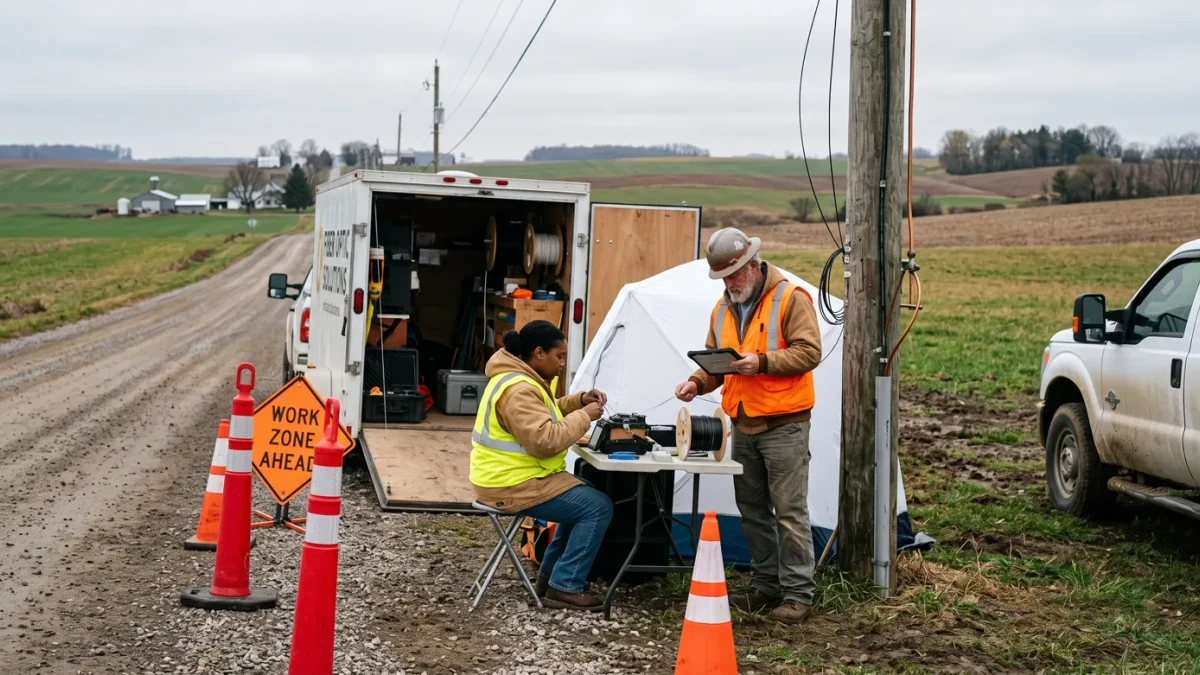
Rural broadband's federal moment is here, late. The 2021 infrastructure law dedicated $42.45 billion through the Broadband Equity, Access, and Deployment program, the largest single connectivity appropriation in history, with allocations to every state based on Federal Communications Commission coverage maps. After documented mapping disputes and slow rollout through 2024 and 2025, shovels and fiber splices are finally reaching counties that DSL forgot. The question this analysis follows is narrower than streaming: what happened to small business in the counties that got connected.
What does the research say broadband does?
The pre-BEAD record, built on earlier USDA and FCC subsidy rounds, is consistent. Connected rural counties documented higher new-business formation, higher farm income through precision-agriculture adoption, measurable growth in home-based self-employment, and, more ambiguously, mixed effects on total employment, because connectivity also exposes local retail to national e-commerce competition. Studies of the Recovery Act-era Broadband Technology Opportunities Program and USDA's ReConnect rounds found the largest gains precisely where adoption programs accompanied infrastructure, a lesson the new law's digital-equity funding tries to institutionalize.
The mechanism is not mysterious. Rural businesses without real upload capacity cannot do cloud point-of-sale, telehealth intake, video production, remote-bookkeeping, or modern state and federal procurement bidding. Where fiber arrived, documented uses include grain-elevator telemetry, veterinary teleconsults, craft e-commerce that replaced wholesale dependence, and remote work recruiting that let counties court residents, not just employers.
Who builds it, and who owns it?
The documented implementation map includes incumbent telcos, electric cooperatives, and municipally built networks, and ownership turns out to be the quiet policy variable. Cooperatives and munis, where state law permits, keep revenue local and price for adoption; research on community networks documents favorable pricing and local multiplier effects, alongside the documented risk of taking on debt in low-density territory. The big incumbents, having declined much of the hardest-to-serve acreage for decades, participate selectively. Counties that negotiated middle-mile ownership, the trunk lines everything else rents, documented the strongest long-term bargaining positions, a structural lesson from the earlier rounds.
What are the documented caveats?
Three. Mapping: FCC coverage data long overstated availability at the census-block level, a flaw Congress's own reviews documented, and BEAD's remapped, address-level data revealed more unserved homes than the original formulas assumed, stretching budgets. Affordability: availability without adoption changes nothing, and rural adoption rates lag even where service exists, tied to price, devices, and skills, which is why the digital-equity and Affordable Connectivity-style subsidies are load-bearing, and their funding volatility is a documented risk. And time: the deployment calendar runs past 2026 for much of the map, so the small-business effects visible now are early returns from the easiest-to-build places.
What should a town do with the fiber?
The documented playbook from connected counties is specific. Train first: libraries and community colleges running digital-skills programs documented higher business adoption. Recruit remote workers deliberately: counties with marketing programs targeting location-neutral employees converted fiber into residential tax base. And fix procurement capability: federal and state contract portals are where rural firms most documented losing bids to better-connected suburbs. The fiber, on the record, is not a development strategy by itself; it is a utility whose returns depend on what the town builds on top of it.