The number of craft breweries in the United States stopped growing and started shrinking. Industry figures compiled by the Brewers Association showed openings falling and closures rising through 2023 and 2024, with 2024 the first year on record that craft closures exceeded openings, and the closure counts tracked higher through 2025 by every industry monitor, from state guilds to the trade press that now runs regular closure roundups. For a sector that had known only expansion since the 1990s, the turn is structural, and its documented geography is Main Street first.
What killed the growth curve?
The demand side went flat. Craft's share of beer volume plateaued around the low teens in dollar terms while the overall beer market contracted, as younger drinkers shifted toward spirits, canned cocktails, and non-alcoholic options. The cost side then squeezed: malted barley and can prices rose with the 2022-2023 inflation wave, and the floating interest rates on the small-business loans that built most taprooms reset painfully. The Brewbound and Craft Brewing Business trade press documented the mechanics repeatedly: a taproom whose loan payment doubled while taproom traffic fell twenty percent has no margin left to absorb it.
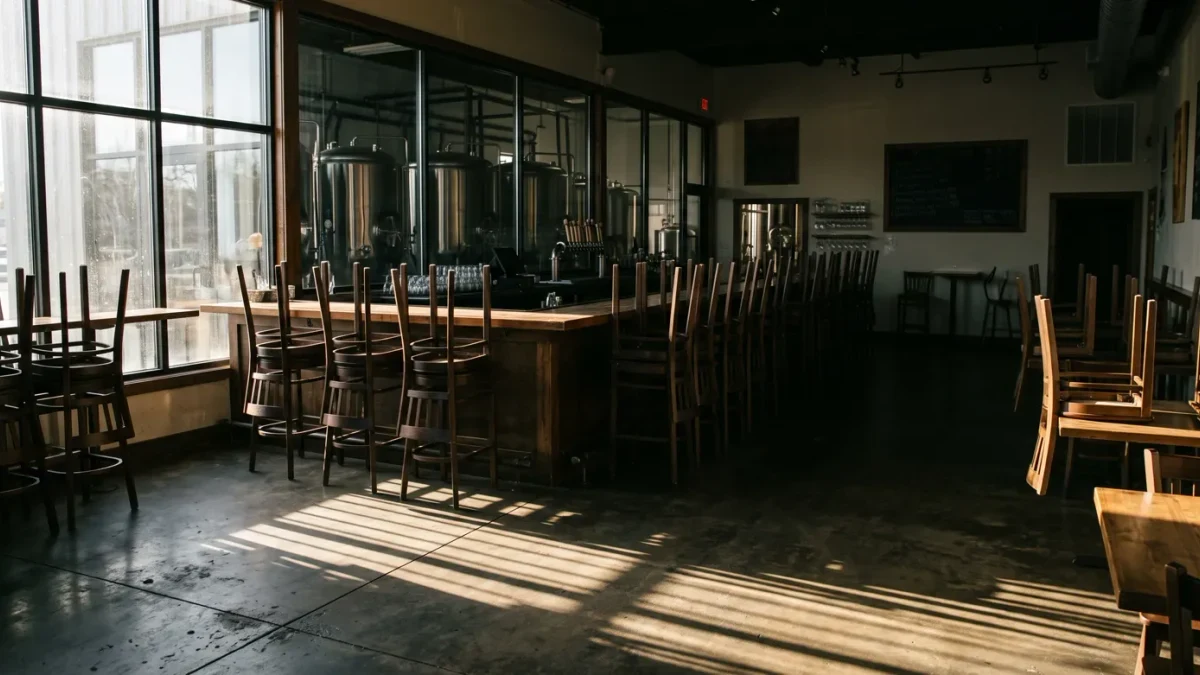
On-premise drinking, where taprooms live, took the specific hit. taproom sales depend on the same downtown and neighborhood foot-traffic patterns that office-attendance data shows at roughly half of pre-2020 levels, and breweries that bet their model on weekday after-work crowds in city cores were documenting the shift in their own point-of-sale numbers by 2023.
Why did taprooms close before production brands?
Distribution protects; taprooms expose. A production brewery selling cans through wholesale has many small customers, while a taproom is a single restaurant with a single product line, one bad lease, one slow season, one broken canning line from insolvency. The closures documented through 2024 and 2025 skew hard toward the smallest producers, and the association's own data shows the surviving volume concentrating in larger regional brands and in destination breweries that became event spaces, a bifurcation familiar from every maturing industry.
What does a brewery closure cost a town?
More than the jobs, which at a typical taproom number ten to twenty-five. Breweries had become documented anchor tenants of small-city revitalization: they occupy the industrial buildings nobody else wanted, at rents that made first-in risk tolerable, and the foot traffic they generated supported adjacent retail. Planning research and downtown-development case studies repeatedly cited breweries as the leading wedge of warehouse-district revival in cities from Asheville to Grand Rapids to Bend. When the anchor goes, the block's economics test reverts to what it was before, which, in the documented revival districts, was vacancy.
The civic loss is also fiscal. Taprooms ran events, hosted little leagues, and functioned as de facto community centers in towns without one, a role documented in guild surveys and local coverage far out of proportion to their payroll. Their closures read locally less like a business story than like losing the hall.
What does the surviving model look like?
The record through 2025 shows three documented adaptations. Multi-taproom brands with distribution, which spread fixed costs and keep the retail margin. The taproom as third place: food programs, family hours, and events that treat beer as one revenue line among several. And contract-plus-alehouse hybrids that shed brewing capital entirely. Meanwhile, the liquid itself is consolidating: as independent breweries close, their shelf and tap handles revert to the two giant distributors, a concentration the Brewers Association has flagged in its competition commentary for years.
The shakeout is not a crash; craft remains a tens-of-billions market with thousands of healthy firms. But the era when every midsize town could support another brewery is over on the record, and the towns that courted breweries as economic development now know what the liquor store always knew: the block keeps the taproom only as long as the taps pay the lease.