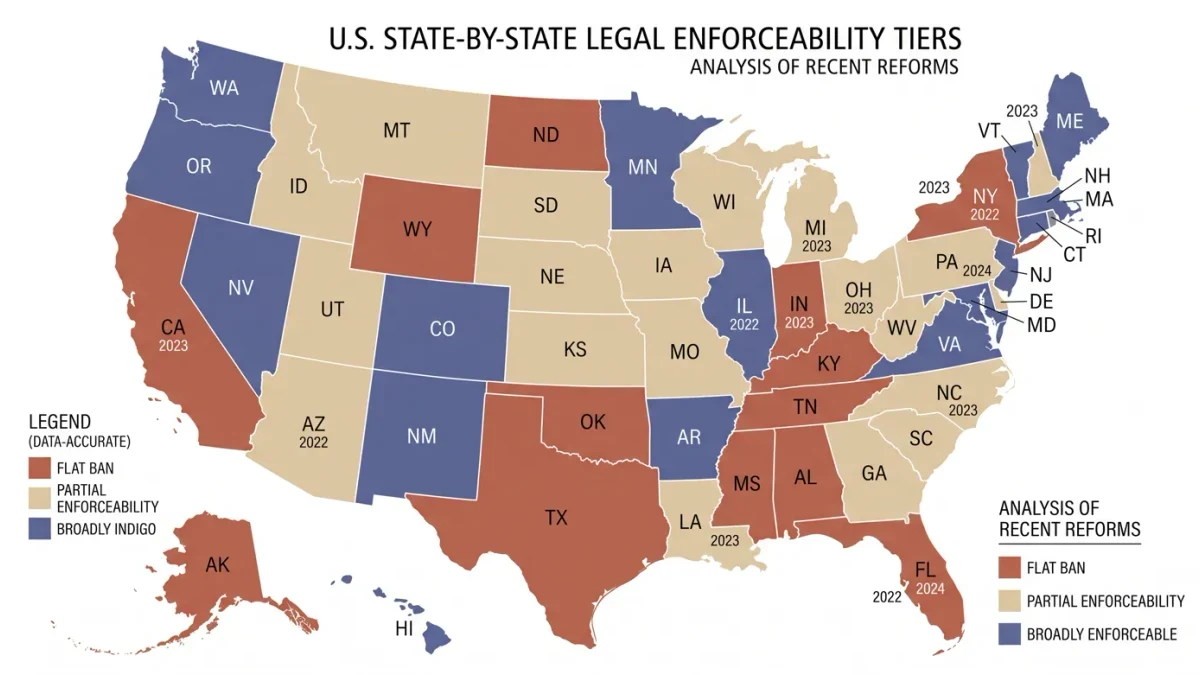
In April 2024, the Federal Trade Commission voted to ban noncompete agreements nationwide, calling them an unfair method of competition that suppressed wages across the economy. In August 2024, a federal judge in Texas set the rule aside before its effective date, and in September the commission declined further pursuit under new leadership, ending the federal experiment. The state-level record the rule briefly interrupted, however, tells a different and continuing story: a decade-long, bipartisan march of state restrictions that has already made noncompetes unenforceable for large classes of American workers.
Why did the FTC rule fail?
The court's reasoning, followed by the rule's formal fate, was that the commission lacked authority to declare a widespread, century-old contract practice an unfair method of competition, a power question rather than a wage question. The litigation record also documented the stakes the agency had cited: its economic analysis estimated noncompetes covered roughly one in five American workers, far beyond the executives the clauses were mythically for, hairdressers, sandwich makers, camp counselors, physicians, and estimated the ban would raise wages by hundreds of billions over a decade, figures the Chamber of Commerce's counterfilings contested.
What have the states done instead?
The documented state map divides into three tiers. Flat ban: California has refused enforcement since the nineteenth century, a policy economists credit, in peer-reviewed studies, for Silicon Valley's job-hopping innovation edge over Boston's Route 128, where noncompetes held. North Dakota, Oklahoma, and Minnesota ban them broadly. Income thresholds: a growing list of states, including Illinois, Colorado, Washington, Virginia, and Maine, void noncompetes for workers below wage floors, sometimes set near the median, protecting the workforce the FTC data showed was actually bound. Procedural limits: notice requirements, consideration rules, and reasonableness tests elsewhere. The 2019-2025 legislative sessions documented a steady drumbeat, with Maryland, Rhode Island, New Hampshire, and others adding or tightening caps, and Massachusetts' 2018 reform requiring garden leave pay as the price of enforcement.
What does the research say the clauses do?
The economics literature documents consistent harms. Noncompetes reduce worker mobility, with studies exploiting state-boundary comparisons showing job-switching, the main wage-growth channel, depressed where clauses are enforceable. They suppress wages not only at bound workers but at their unbound colleagues, whose alternatives weaken. They slow knowledge diffusion, the California-Boston comparison again, and regional entrepreneurship, since starting a rival firm is the ultimate breach. The defense case is narrower but documented: employers claim protection for genuine trade secrets and training investments, and the empirical literature concedes the case for a small, senior, truly secret-holding class, which is exactly the carve-out most state regimes now write.
What are employers doing now?
The documented adaptation is substitution into adjacent covenants, nonsolicitation clauses barring poaching of customers or colleagues, nondisclosure agreements stretched to function as noncompetes, and training-repayment agreements, TRAPs, whose spread the labor-law literature documents as the new frontline, with several states already regulating them. The FTC's loss did not end the enforcement conversation: its challenge to no-poach agreements between franchises proceeded on different authority, and state attorneys general documented active investigation of naked wage-fixing and no-poach arrangements, conduct no one defends.
What should a worker with one of these clauses do?
Read the governing-law paragraph first, since clauses often import a friendly state's law, and several states now void that choice for residents. Check the wage threshold in your state, which voids the clause outright for most non-executive earners. And know that the documented pattern of practice, demand letters to departing workers, rarely survives a challenge in the restrictive states, because the employer must sue in the worker's state, and the clause dies there. The nationwide ban failed; the clause-by-clause retreat, in fifty legislatures, is documented and continuing.