Overtime eligibility turns on a number most workers have never read: the minimum salary below which an employee must receive time-and-a-half for hours over forty, regardless of job duties. In 2024, the Labor Department raised that threshold in steps toward roughly $58,600, the largest increase in the rule's history, extending overtime rights to millions of assistant managers and salaried professionals. In November 2024, a federal judge in Texas struck the rule down, resetting the enforceable level to $35,568, where it stood in 2026. The reversal, decided on a technicality of statutory authority rather than policy, is the latest round in a rule war that has now spanned four administrations.
The Press Times publishes information, not legal advice; employers and workers with live disputes should consult counsel or the Wage and Hour Division.
Why does a salary number carry so much weight?
The Fair Labor Standards Act exempts bona fide executive, administrative, and professional employees from overtime, and since 1975 the regulations have required that exempt employees be paid both a salary, at or above the threshold, and perform exempt duties. The salary test exists to prevent title inflation, the assistant manager who is a manager in name and a barista in fact, from converting overtime-eligible hourly work into exempt flat pay. The threshold's history documents the stakes: had it kept pace with inflation since 1975 it would exceed $60,000 today; frozen for decades, it sank until the 2019 rule set $35,568, a level covering full-time workers earning under roughly $17 an hour.
What happened to the 2024 rule?
The 2024 rule raised the level in two steps, July 2024 to about $43,888 and January 2025 to about $58,650, with automatic indexation thereafter. Business groups and states sued, and in November 2024 the U.S. District Court for the Northern District of Texas vacated the rule nationwide, holding that the salary level was set so high it effectively displaced the duties test, exceeding the department's authority, the same reasoning a different Texas court had used to void the Obama-era 2016 rule, which would have reached $47,476. Workers whose salaries sat between the two numbers held overtime rights for a few months of 2024; the vacatur extinguished them retroactively in effect, and documented reclassification back to exempt status followed.
Who actually sits below the threshold?
Department analyses accompanying the rule documented the affected workforce: disproportionately women, disproportionately Black and Hispanic workers, concentrated in retail management, food service, insurance claims, banking branch staff, and long-term-care administration, the exact occupations where 50-hour weeks at flat salaries are common. The rule's proponents documented billions in transferred wages; opponents documented compliance costs and salary compression, the problem of raise-triggering thresholds that flatten differentials just above the line. Both effects are real in the record of prior increases, which makes the fight genuinely about distribution rather than arithmetic.
What can employers and workers rely on now?
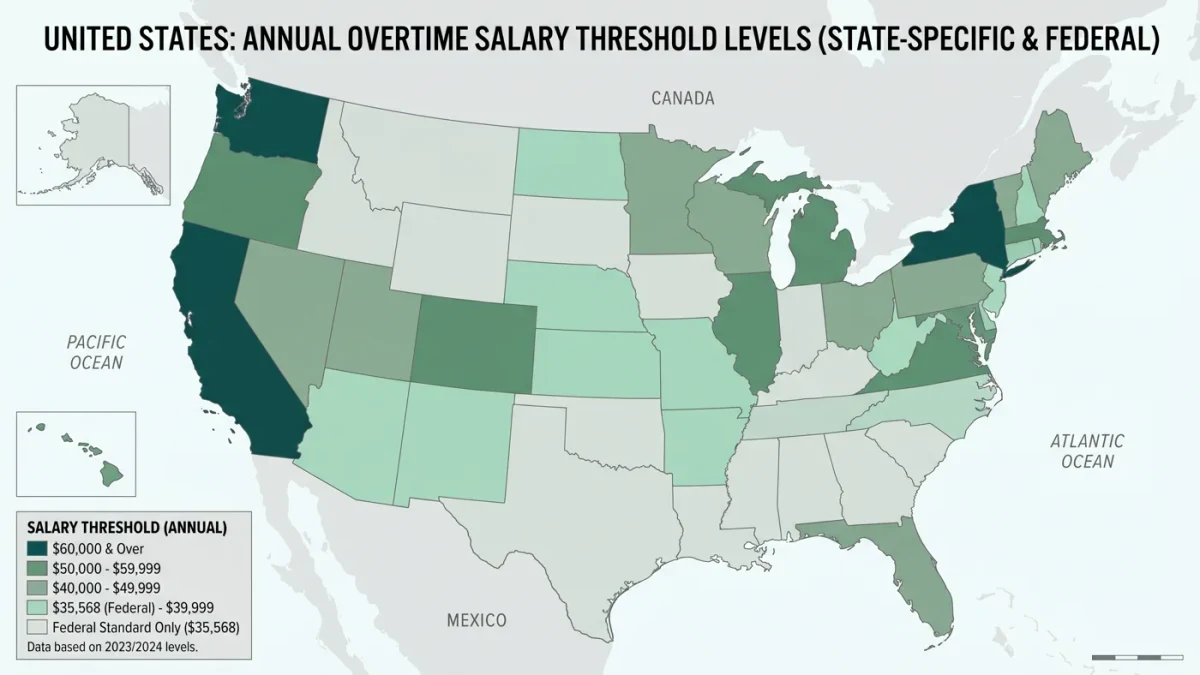
The enforceable floor in 2026 is $35,568 plus the duties test, and the highly compensated employee total-compensation bar of roughly $107,432 from the 2019 rule. But the state map overrides: California, New York, Washington, Colorado, and Alaska, among others, set higher state salary thresholds for exemption, tied in some cases to state minimum wages, with California's exempt-salary floor mechanically tied to a multiple of the state minimum wage, such that every January wage increase raises the exemption bar. Multistate employers therefore run a compliance matrix, and the documented trend, state thresholds climbing while the federal number is litigated to a standstill, mirrors the minimum wage and paid-leave pattern: the states are doing the federal government's adjusting.
What happens next?
The appellate sequels of the vacatur and any future rulemaking will take years, and each administration has now rewritten or unwritten its predecessor's number. Watch two things: whether the department appeals and revives automatic indexation, the feature with the largest long-run effect, since it removes the freeze-then-fight cycle; and whether Congress, which has the unambiguous authority, ever legislates a number. Until one of those happens, the governing principle is the one the record documents: your overtime rights depend less on what you do than on which state's map you do it in.