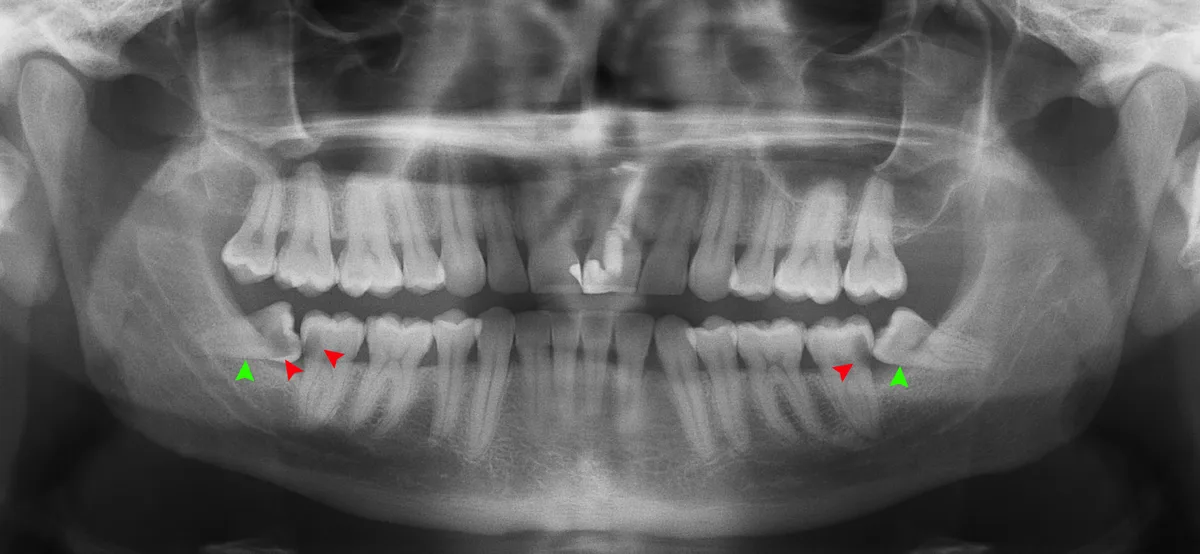
Wisdom teeth get impacted because they are the last teeth to arrive, and by the time they show up, the jaw often has no space left for them. A tooth is called impacted when it cannot fully break through the gum or sit in a normal position. Instead, it stays stuck — angled, half-emerged, or completely buried.
Most people get these third molars in the late teens or early twenties, an age long associated with growing up. That timing is where the name comes from: the word wisdom has long stood for mature judgment, and the teeth earned their label by appearing when a person was thought old enough to have some. The irony is that the teeth are a leftover, not a milestone, and the modern jaw frequently treats them as uninvited guests.
This explainer covers why the crowding happens, what an impacted tooth actually does in there, and how dentists and patients sort the teeth that need attention from the ones that can be left alone. Readers following this should also see The Impact of Volunteering on Your Career: What Service Work Actually Builds.
Why is there no room for wisdom teeth?
The short answer: modern jaws are often smaller than the teeth they have to hold. Third molars are the very last of the four molar types on each side, top and bottom, and they erupt after every other permanent tooth has already claimed its spot. If the dental arch behind the second molars is too short, the wisdom teeth have nowhere to go. This connects to our earlier piece, The Retraining Pledges AI Left Behind.
Several forces seem to shape that shortfall. Jaw size varies from person to person, and a smaller lower jaw leaves less room at the back. Diet plays a role in how jaws develop during childhood; a softer, processed diet has been linked in the dental literature to less jaw growth than the tougher chewing that earlier human diets demanded. Human faces and jaws have also gradually changed over long stretches of time, and smaller jaws are part of that trend. None of this is a single clean cause. It is a squeeze produced by several slow-moving factors at once.
The result is a simple geometry problem. Four large teeth arrive last, angled forward, into a space that may be a few millimeters short. When the space runs out, the tooth stops moving and becomes impacted.
What does an impacted wisdom tooth actually do?
Impaction is not one condition. It comes in several positions, and the position drives the risk.
- Fully bony impaction: the tooth sits completely inside the jawbone, covered by bone and gum. It may cause no trouble at all, or it may press on the root of the neighboring molar.
- Partial bony impaction: part of the tooth has broken through the gum. This is the position most associated with trouble, because the flap of gum over the tooth traps food and bacteria.
- Soft-tissue impaction: the tooth has cleared the bone but is still capped by gum tissue, which can swell and get infected.
- Angled eruptions: the tooth may come in tilted toward the front (mesial), tilted backward (distal), sideways (horizontal), or straight up but jammed against the second molar.
The most common complications are straightforward. A partially erupted tooth is hard to clean, so plaque and bacteria collect around it. That can produce pericoronitis — a swollen, painful gum infection around the crown. Food packing behind the second molar raises the risk of decay on both teeth. In some cases, an impacted tooth presses on or grows against the adjacent molar's root, a problem dentists call resorption, which can damage a healthy tooth. Cysts can also form around an impacted tooth in the jawbone, which is one reason dentists keep watching them on X-rays even when nothing hurts.
Does an impacted tooth always need to come out?
No — and this is where the guidance has genuinely shifted. For decades, many clinicians removed symptom-free wisdom teeth as routine prevention. Today the mainstream position is more patient: an impacted tooth that is fully buried, causing no pain, no decay, no damage to neighboring teeth, and showing no signs of cysts or infection can often simply be monitored.
What this means in practice: the decision rests on findings, not on the mere fact of impaction. Dentists typically weigh the tooth's position, its angle, how much of it has erupted, the health of the second molar beside it, and what follow-up X-rays show over time. Removal makes clear sense when a tooth is repeatedly infected, is decayed in a spot no brush can reach, is damaging the adjacent molar, or is associated with a cyst or bone change. Watchful waiting makes sense when none of that is present — with the understanding that the picture can change and the tooth can be removed later, when surgery is often somewhat easier on a younger patient than on an older one.
The reverse also holds: not every ache in the back of the mouth is the wisdom tooth's fault. Soreness there can come from gum inflammation, a cavity in the second molar, or jaw strain. A proper exam with imaging is what separates the real culprit from a nearby suspect.
What does removal involve, and what are the risks of waiting?
Extraction of an impacted third molar is one of the most common surgical procedures in dentistry. The difficulty scales with the impaction: a tooth buried deep in the bone and lying sideways takes more work than one tilted mildly forward near the surface. Recovery typically involves a few days of swelling and a soft diet, with the socket healing over the following weeks.
The risks of surgery — bleeding, infection, dry socket, and, rarely, temporary or lasting nerve effects in the lower jaw — are real but uncommon, and they rise with age and with the depth of the tooth. The risks of waiting are also real: infection, decay in the adjacent molar, cyst formation, and sudden pain at an inconvenient moment. Neither column is empty, which is why the honest answer to "should mine come out?" is that it depends on what the X-ray and the exam show, not on a rule that applies to everyone.
Practical steps for anyone weighing this:
- Get a panoramic X-ray or similar imaging so the tooth's position and the neighboring molar are visible.
- Ask specifically whether the tooth is touching the second molar's root, and whether any bone change or cyst is visible.
- If the recommendation is monitoring, ask how often it should be rechecked and what warning signs should trigger a visit.
- If the recommendation is removal, ask about the tooth's depth and angle, since those drive both the surgery and the recovery.
The takeaway
Impacted wisdom teeth are a mismatch between old equipment and new housing: four late-arriving molars meeting a jaw that grew smaller than the one their owners' ancestors had. Impaction itself is not a diagnosis of trouble — it is a position, and positions carry different levels of risk. The evidence-based path is neither automatic extraction nor automatic neglect. It is imaging, a specific conversation about what the X-ray shows, and a monitoring plan or a surgery date based on findings. The teeth may be named for wisdom; the decision about them is where it actually gets applied.