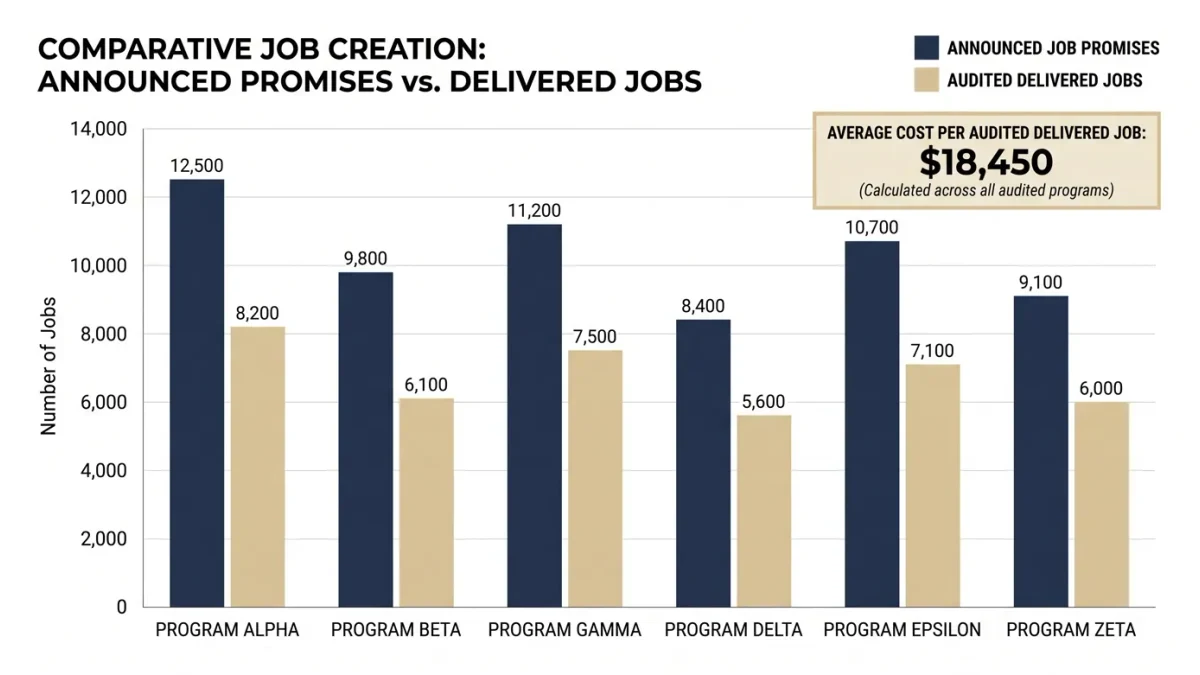
Every state in the union, and thousands of counties, pays companies to create jobs: tax credits, abatements, cash grants, free land and infrastructure, a category of spending that economic-development researchers at Good Jobs First and academic trackers estimate at more than $30 billion a year. And every year, a smaller set of auditors goes back to check what arrived. The documented answer, across state auditors general from Missouri to Maryland, is a gap: programs routinely deliver a minority of the jobs their agreements projected, while cost-per-job figures cluster well above the wages the jobs pay.
What do the audits actually find?
The state auditor genre is consistent enough to have house style. A Missouri auditor's report on the state's flagship programs found a majority of tax-credit recipients delivered fewer jobs than promised, with clawbacks rarely pursued. New Jersey's auditor documented millions in credits to companies that cut employment. Kansas and Maryland reviews found job-creation figures unverifiable because agencies did not require payroll proof. The pattern is not conspiracy; it is mechanism: incentives are negotiated at announcement, when projections are optimism, verified by agencies with no enforcement budget, and politically protected at clawback time, because no governor wants the headline of seizing jobs from a company that stayed, partially.
What separates deals that deliver?
The evaluation literature, including the rigorous comparisons in the Journal of Economic Perspectives and the Upjohn Institute's program scores, documents the correlates of delivery. Contracts with specific, dated job numbers, wage floors, and automatic clawbacks outperform handshake deals by large margins. statutory, transparent programs beat discretionary deal-closing funds, which the same literature documents as the most expensive per job with the weakest verification. And incentives work best where the investment would plausibly not have happened anyway, which is why the finding recurs that most incentive spending subsidizes behavior that was coming regardless, a deadweight economists estimate at the majority of program cost.
Why do the megadeals keep failing biggest?
The Foxconn case remains the canonical document: a Wisconsin project announced in 2017 with 13,000 promised jobs and $3 billion in promised state support that built a fraction of both, an outcome documented in state reviews and federal indictments of executives. The 2020s repeated the pattern at smaller scale in EV and battery deals, where demand softness paused projects whose incentive contracts assumed the optimistic case. Megadeals fail for structural reasons: they concentrate political pressure to announce, they due-diligence fastest where scrutiny is weakest, and their success conditions, global demand, technology readiness, require forecasting no contract can enforce.
What would honest incentive design look like?
The documented reform list is old and tested: sunset every program and re-authorize on evaluation; cap per-job cost and require wage and benefit floors tied to local medians; fund the verification office, payroll data access for auditors is the single highest-return line item in the literature; make clawbacks automatic rather than discretionary; and disclose deals at signing, since secrecy is the documented correlate of the worst outcomes. A handful of states adopted pieces of this in the late 2010s and 2020s, and the early evaluations of disclosure-plus-clawback regimes document improved delivery without any measurable loss of deal flow, evidence against the claim that accountability kills recruitment.
What should citizens ask their economic-development officials?
Three questions, each answerable from documents: What did we pay per job actually verified, not announced? Which companies got abatements while cutting payroll here? And when was the last clawback enforced? The silence that follows the third question is, on the audit record, the sound of the whole system working as designed, for the companies. Jobs programs that cannot verify jobs are not jobs programs; they are transfer programs with a press release attached, and the audits, patiently, year after year, keep writing that sentence down.