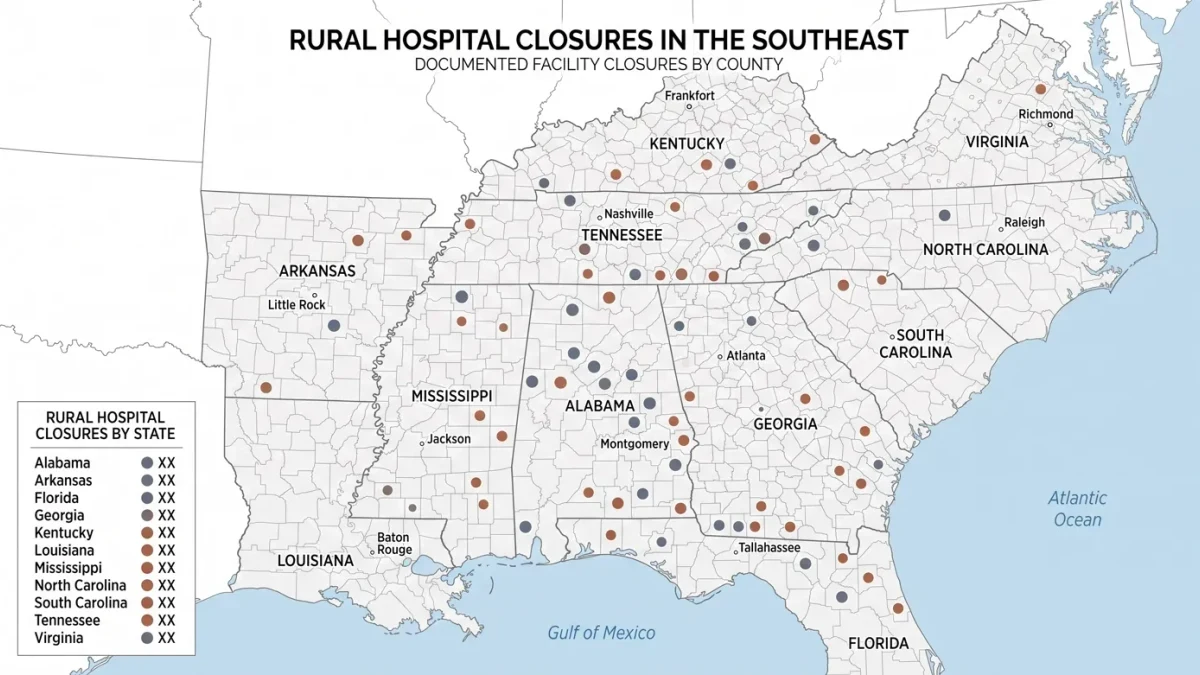
When a rural hospital closes, the first number a county feels is not clinical but payroll. The University of North Carolina's Sheps Center, which maintains the definitive closure tracker, counted more than 190 rural U.S. hospitals closed or converted away from inpatient care since 2005, and in most of those counties the hospital had been among the top employers. The loss lands on nurses, cafeteria suppliers, laundry contracts, and the property tax roll at the same time.
How much of a county economy does a hospital hold?
Hospitals are unusual anchor employers because nearly every dollar of their revenue imports money into a community: Medicare, insurers, and patients from surrounding counties pay in, and the institution spends locally on salaries first. Federal rural-health researchers have long estimated each hospital job supports roughly one to two additional local jobs through supply purchases and household spending. A 100-bed rural hospital typically employs 300 to 600 people directly, on payrolls that often exceed every other private employer in the county combined.
The Sheps Center data shows the closures cluster in the Southeast and lower Midwest, in counties that are older, poorer, and more dependent on public insurance than the national average. That clustering matters: the same demographics that make a hospital financially fragile also make the community least able to absorb the loss.
What happens to the workforce after the doors close?
The documented aftermath follows a pattern. Clinical staff, particularly nurses, usually find work, but often 30 to 60 miles away, which converts a local payroll into a commuter payroll: the wages still arrive, but the lunch, the gas fill-up, and the after-school program move with the commute. Older workers near retirement frequently exit the labor force early, a documented drain on participation in closure counties. Front-line support staff, from environmental services to billing clerks, face the hardest market, because those roles rarely exist elsewhere locally.
Emergency response recalibrates around the gap. Counties that lose inpatient care frequently formalize longer EMS transport times, and published studies of closure counties have documented modest but real increases in time-sensitive health outcomes risk for conditions like heart attack and trauma. County governments also lose the hospital's standby role during floods and storms, when a local emergency department doubles as the community's shelter medicine.
What does the tax roll look like afterward?
A nonprofit hospital often pays little property tax, but it anchors the taxable value around it: clinics, pharmacies, medical office buildings, and staff housing. Post-closure, counties have documented declining appraisal values for medical-adjacent commercial property, and several closure counties have used state pilot programs or local-option sales taxes to backfill ambulance and clinic subsidies. School districts feel it through the same levy base. The fiscal hole rarely closes; it gets managed.
What has actually kept hospitals open?
The record shows a few effective interventions. Converting to a rural emergency hospital, a federal designation created in 2023 that pays a monthly facility fee for stand-alone emergency care, has preserved some access where inpatient volume had already collapsed. State programs that directly subsidize struggling facilities have measurable records in Georgia, Pennsylvania, and elsewhere, though budget hawks note the subsidies buy time rather than fix the payer mix. And affiliation with a larger system, when it preserves local services rather than stripping them, has kept doors open in counties that could not finance capital repairs alone.
What the record does not show is spontaneous recovery. No documented case in the Sheps Center data involves a full-service hospital returning to a county after closure. The policy question, therefore, is not whether closures can be reversed but which counties get help before the last admission is processed.
What should residents watch?
The leading indicators of distress are public: bond downgrades, layoffs of traveling staff, loss of obstetric services, and suspension of chemotherapy or surgical lines months before any closure announcement. Counties that track those signals early, and negotiate conversion rather than closure, have kept more of both the care and the jobs. The hospital that leaves takes an emergency room with it, but it also takes the county's largest biweekly deposit, and the data says the second loss is the one that lasts.