When the owner of a decades-old manufacturing company retires, the documented alternatives are few: sell to a competitor that may move the plant, sell to private equity that may strip it, or close it. A fourth option, selling to the employees through an employee stock ownership plan, has quietly grown into a major corner of the economy. The National Center for Employee Ownership counts more than 6,000 ESOPs covering over 10 million workers, and federal data shows the fastest growth in exactly the demographic that needs it most: closely held companies whose founders are at retirement age.
What is an ESOP, mechanically?
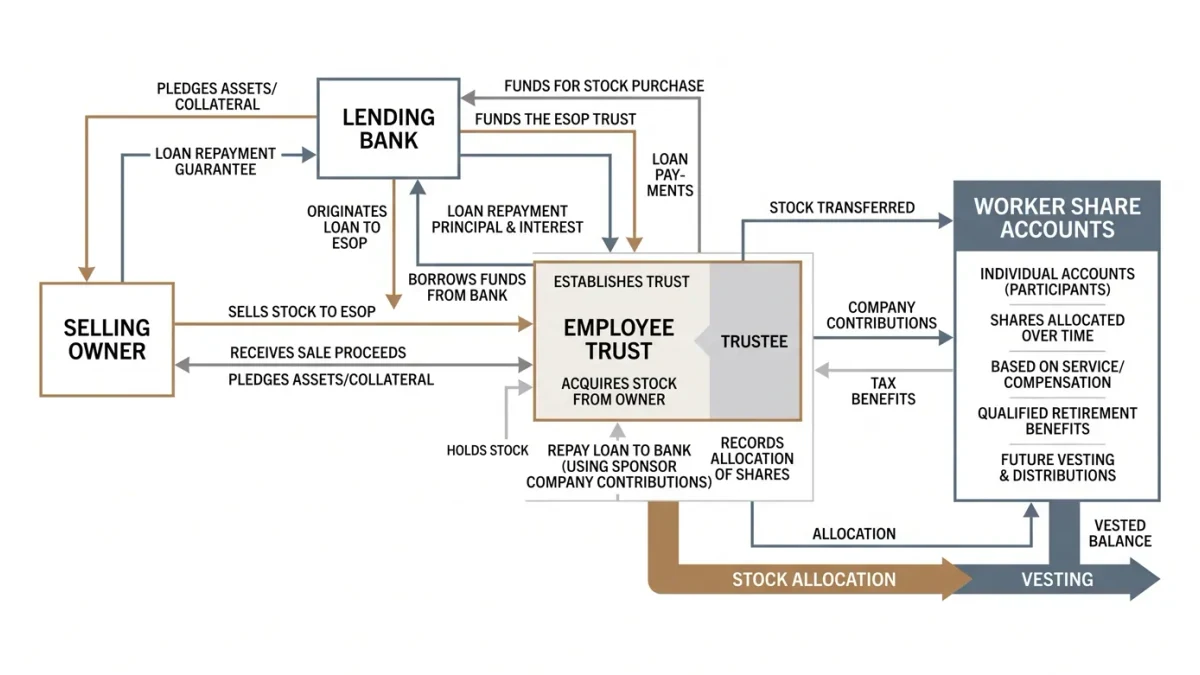
An ESOP is a trust that borrows money to buy the company from its owner, then allocates shares to employees' accounts as the loan is repaid. Workers pay nothing out of pocket; their accounts fill over years of service, and they cash out at retirement or departure at fair-market value. The structure carries some of the most generous tax treatment in the federal code, including the provision, expanded by Congress in the 2017 and subsequent tax laws, that lets S-corporation ESOPs operate essentially federal-income-tax-free at the company level. That arbitrage explains much of the growth: a 100 percent ESOP-owned S-corp competes with a meaningful structural cost edge.
What happens to the town?
The documented local effects run through three channels. First, the plant stays. ESOP conversions are, by construction, sales to the incumbent workforce, so the relocation risk embedded in a strategic sale is removed; studies comparing ESOP and non-ESOP firms during downturns, including work through the Great Recession, found ESOP companies markedly less likely to close or lay off staff. Second, wealth builds where wages were spent. Because allocations are broad-based and vest over time, the median production worker at a mature ESOP regularly carries an account worth six figures, retirements that in acquired plants would have left as executive proceeds. Third, the tax efficiency funds reinvestment, and several documented conversions directed the retained cash into capital equipment the prior owner had deferred.
The pattern is visible on Main Street. Company towns that lived through a leveraged-buyout generation, watching acquirers resell every five years, now market stability to workers: the ESOP sign in the parking lot is a promise the plant will not be moved by a fund that has never seen the river it sits on.
Where do ESOPs fall short?
The record is not uniformly rosy, and honest coverage carries both sides. ESOP accounts are undiversified: workers hold both job and retirement in one company, and when an ESOP firm fails, the damage is total, a risk documented in several insolvency cases where workers lost employment and equity at once. Valuation abuse has produced enforcement actions, with Department of Labor cases against trustees who overpaid selling owners at workers' expense. And governance is often thinner than the rhetoric: employees own the stock but rarely control the board, so ownership can feel like a savings plan wearing a culture video.
critics also note that the tax benefits flow disproportionately to companies that were already profitable, and that the mechanism does nothing for the gig, retail, and service workforce outside its mostly industrial base.
What is the policy drift?
Bipartisan interest has grown precisely because ESOPs answer two problems at once: the baby-boomer business-succession wave, with trillions in enterprise value seeking buyers, and regional inequality that worsens when hometown firms are acquired and moved. Congress has repeatedly introduced bills to expand ESOP financing through the SBA, whose 2024 rule change re-allowed ESOP loans in the flagship 7(a) program, and states including Ohio, Indiana, and Colorado fund ESOP outreach centers. The documented gap between interest and adoption is financing and expertise: conversions require appraisers, trustees, and lenders comfortable with the structure, infrastructure thin outside industrial corridors.
What should a worker in one watch?
Read the annual valuation statement, the one document the law guarantees. Watch the repurchase liability, the accumulating obligation to buy back shares of departing retirees, which has strained undercapitalized plans. And treat the diversification rule, which lets participants shift ESOP balances into other investments from age 55 onward, as a risk-management tool rather than a betrayal of the culture. The factory the workers bought is a real institution with real wins in the record, and it protects its owners, like any other asset, when they do not bet everything on a single address.