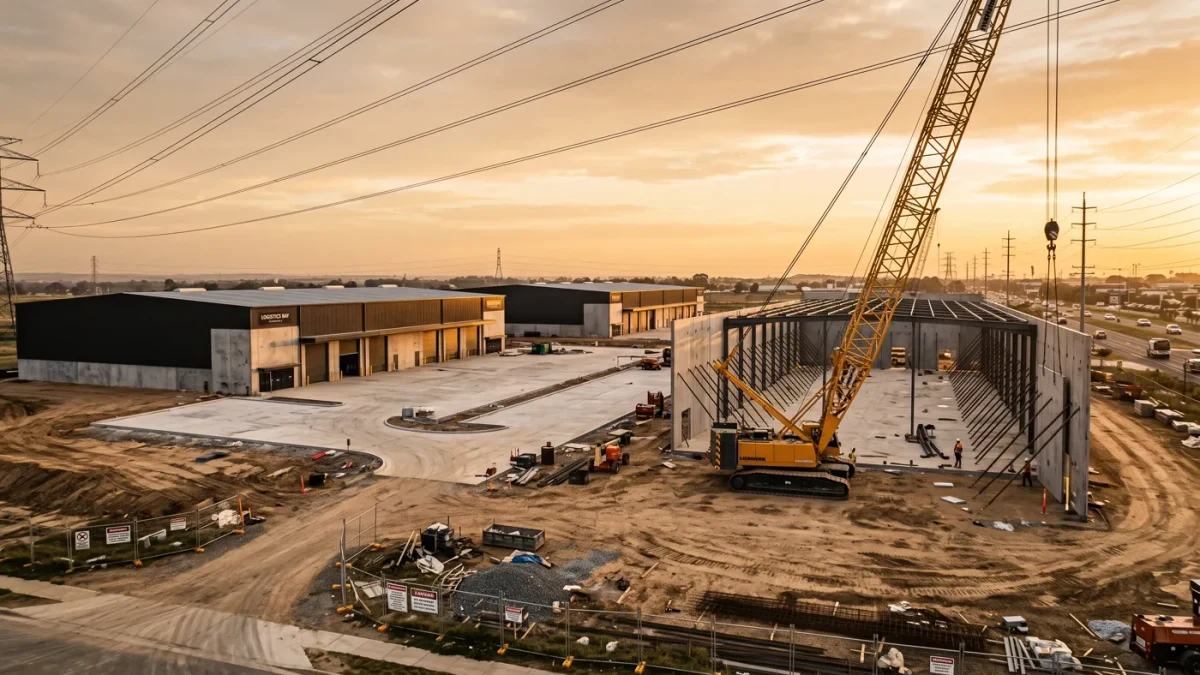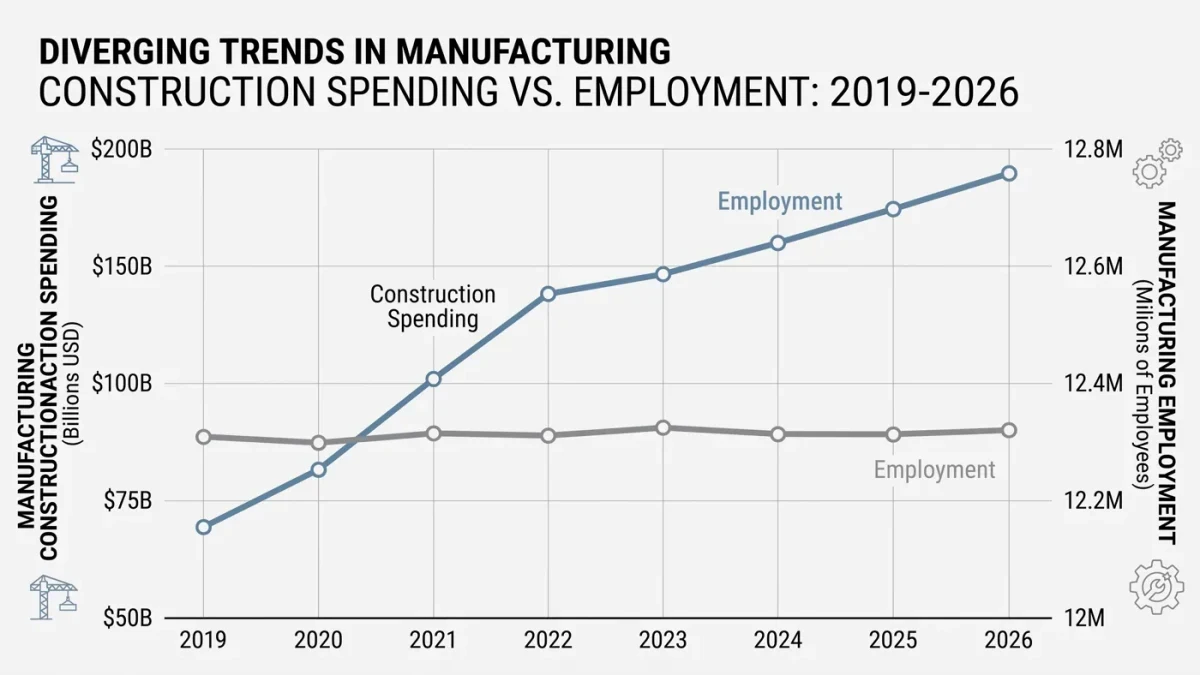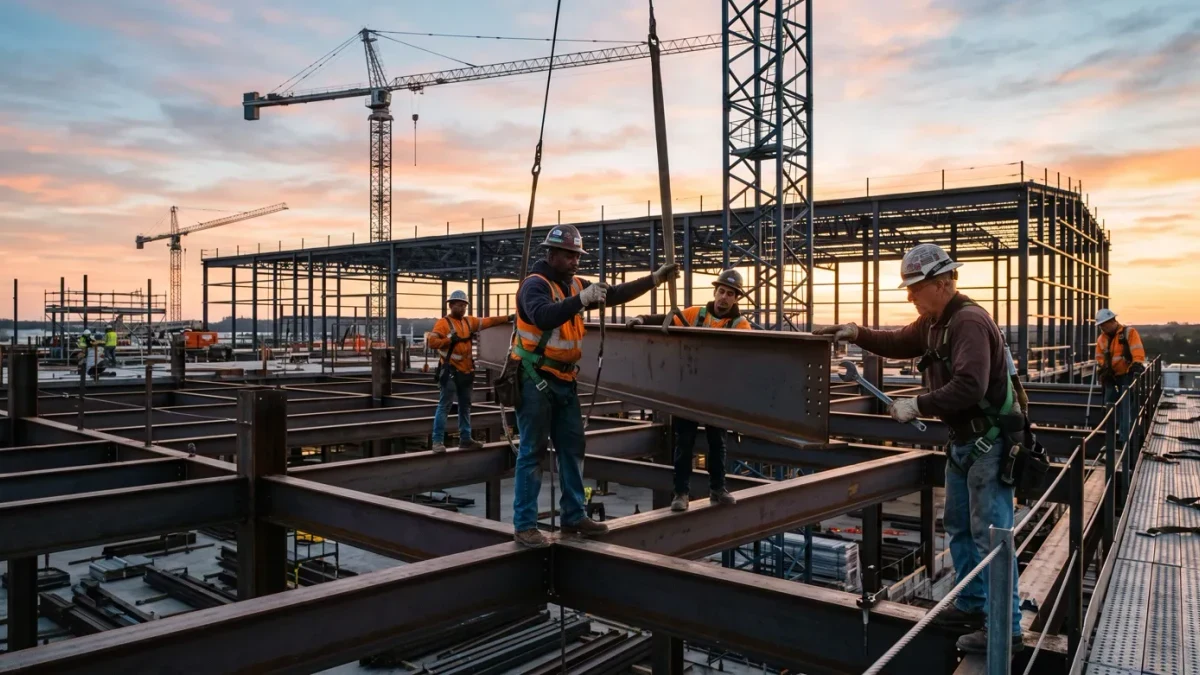
For all the ribbon-cuttings, the most dramatic number in American reshoring is a construction statistic. Real spending on manufacturing facilities, tracked by the Census Bureau, roughly tripled from its pre-2022 norm to a record annual rate above $230 billion and stayed there through 2025, a boom without precedent in the series. Semiconductors, batteries, electric vehicles, and pharmaceutical plants account for most of it. The workforce building those facilities, electricians, pipefitters, crane operators, concrete crews, is the first documented jobs wave of the reshoring era, and it arrives years before the production jobs do.
Where is the construction money going?
The Census data, supplemented by Treasury Department analyses of CHIPS and Science Act incentives, shows computer and electronic manufacturing as the epicenter: semiconductor fabs in Arizona, Ohio, Texas, and New York, plus the battery and EV cluster from Michigan through Georgia and into the Carolinas. Treasury economists documented that real manufacturing construction in the computer-electronics category multiplied severalfold after the incentives passed, an investment response visible at county scale: single sites in rural Arizona and central Ohio that now rank among the largest construction projects in the Western Hemisphere.
The public money is large but not the whole story. Tariff policy, supply-chain shocks, and defense-procurement preferences all pushed in the same direction, and company announcements tracked by the Reshoring Initiative have run at several hundred thousand jobs announced per year.
Who gets the construction work?
The documented pattern is a tight local labor market with a commuting workforce. Fabs and battery plants sit mostly in exurban or rural counties whose own trades base is thin, so the work first goes to travelers, union halls across the Midwest and South have documented dispatches and per-diem assignments to fabs hundreds of miles from home, and to apprentices pulled into registered programs at record rates. Electricians and pipefitters have seen the tightest squeeze; contractor surveys through 2024 and 2025 consistently ranked skilled-labor shortage as the top project risk, ahead of materials.
For host counties, the construction phase is a fiscal event: months of motel occupancy, restaurant volume, and local purchases tax, followed by the risk that the permanent plant hires fewer people than the site once housed in builders. County officials who lived through the phase have learned to budget it as temporary income.
Do the factory jobs materialize?
The record so far is genuinely mixed, and the honest accounting separates three categories. Completed projects, notably the first wave of chip-adjacent and supplier plants, are hiring, and TSMC's Arizona operations documented staffing milestones above initial projections. Delayed projects are the larger middle: several headline fabs and battery plants pushed production timelines right, citing labor shortages, permitting, demand softness in EVs, and shifting policy. And some announcements were always political documents, groundbreakings on projects whose financing never closed; researchers who track announcement-to-operation conversion caution that the announcement count is an upper bound on reality.
The policy instability cut both ways. Incentive programs were renegotiated and litigated through 2025, and Reuters and Bloomberg documented individual projects pausing while rules moved. Capital, once committed to concrete, rarely leaves; capital still on paper, however, waits.
What happens when construction ends?
The construction plateau is the thing to watch, because a building boom that triples spending cannot triple forever. When fab shells finish, the trades move on, and host counties face the transition from thousands of builders to hundreds or low thousands of operators. The operators are different workers: process technicians, maintenance specialists, cleanroom staff, roles that counties compete to train for through community-college partnerships, several of which, in Arizona, Ohio, and Texas, are documented in state higher-education budgets.
The reshoring bet, stated plainly, is that the permanent payroll plus the supplier ecosystem that follows a fab outweighs the public cost of attracting it. The construction data proves the first half of the bet is being placed. Whether it pays is a question the production lines, when they finally start, will answer.