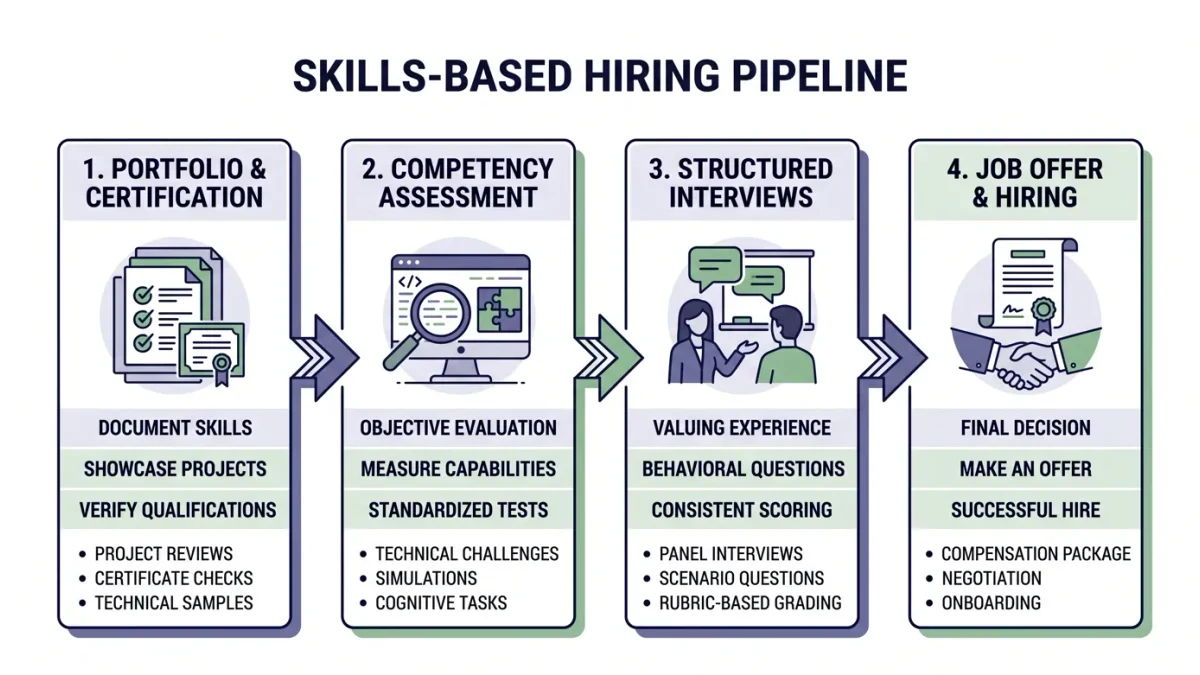
Skills-based hiring, the practice of dropping bachelor's-degree requirements from job postings and screening for demonstrated skills instead, moved from conference talk to corporate policy at remarkable speed. Research by the Burning Glass Institute and Harvard's Project on Managing the Future of Work documented that the share of postings requiring a degree fell substantially between 2017 and 2023, with major announcements from IBM, state governments, and, in 2024, a high-profile federal hiring overhaul. The harder question is what happened to the applicants without degrees. There the data is thinner, and thinner in a way that should concern anyone selling the policy as a silver bullet.
How big is the shift?
The documented numbers are material. The Burning Glass-Harvard studies found employers reduced degree requirements in a large fraction of the occupational categories they examined, and states including Maryland, Pennsylvania, Utah, and New Jersey rewrote civil-service classifications covering tens of thousands of positions. In 2025 the federal government's own hiring reform went further, directing agencies to emphasize skills assessments, a change whose scale, covering the government's roughly two million civilian jobs, has no private-sector parallel.
The economics driving the change predate the politics. College wage premiums plateaued, student-loan balances passed $1.7 trillion, and employers in tight labor markets discovered that arbitrary degree screens were discarding qualified applicants. Demographic arithmetic did the rest: as the number of college graduates grows more slowly than retirements, employers who keep the filter are fishing in a shrinking pond.
Did hiring of non-degreed workers actually rise?
Here the record splits. The postings changed faster than the hires. Follow-up analysis by the same researchers found that many employers who removed degree language did not proportionally increase the share of hires without degrees, suggesting the requirement was often removed from postings where it was not really being enforced anyway. The strongest documented gains came in middle-skill tech and operational roles, where certifications, portfolios, and work samples substitute credibly for a transcript. In licensed fields, from nursing to law, requirements largely stood untouched because statutes, not recruiters, set them.
For workers, the practical consequence is that the door opened widest where skills can be shown quickly: IT support, cybersecurity operations, sales, project coordination, and skilled trades supervision. Where the skill is hard to demonstrate in an interview, degree screens have been slower to fall.
What replaced the degree screen?
Documented replacements fall into three families. Skills assessments, from coding tests to structured work samples, are the most direct substitution and the most legally exposed, since any test with disparate impact must be validated under civil-rights guidance, a constraint the Equal Employment Opportunity Commission has enforced for decades. Work-history heuristics, years of experience in named tools, are the most common and the least rigorous. And the fast-growing middle is third-party certification, with CompTIA, Google Career Certificates, and industry bodies reporting enrollment surges through the period.
Who benefits, and who is left out?
The demographic case for skills-first hiring is documented and strong: Black and Hispanic workers are underrepresented among bachelor's holders and overrepresented among the affected job categories, so removing an arbitrary screen widens the funnel. Rural workers, veterans, and caregivers re-entering the workforce appear repeatedly in employer case studies as the hires the old filter missed.
But two caveats deserve equal billing. First, the degree premium itself has not vanished; federal wage data continues to show large lifetime earnings gaps by education, and the fields dropping requirements are not the fields where the premium is largest. Second, apprenticeships and paid training pathways, the infrastructure that makes skills-first real rather than rhetorical, remain far smaller in the United States than in peer economies, a gap registered in Labor Department statistics on registered apprenticeships.
What should a job seeker take from this?
Treat the posting as negotiable and the assessment as the real gate. The documented winners under the new regime arrive with proof: a certification, a portfolio, a GitHub history, a journeyman card. The documented losers are workers who heard the pledge and assumed the market had changed more than the paperwork had. The degree has been demoted from requirement to tiebreaker, but in a tie, the tiebreaker still wins.