The American retirement at 65 is now a minority practice. Bureau of Labor Statistics data documents labor-force participation among workers 65 and older roughly doubling from its mid-1980s low to around one in five, with the 55-to-64 bracket running near two-thirds. The 2008 financial crisis pushed a cohort back to work, the pandemic briefly pulled older workers out, and the years since documented a rebound that surprised demographers: instead of the great retirement continuing, older workers came back, and participation at the oldest ages sits near its recorded highs.
Why are they staying?
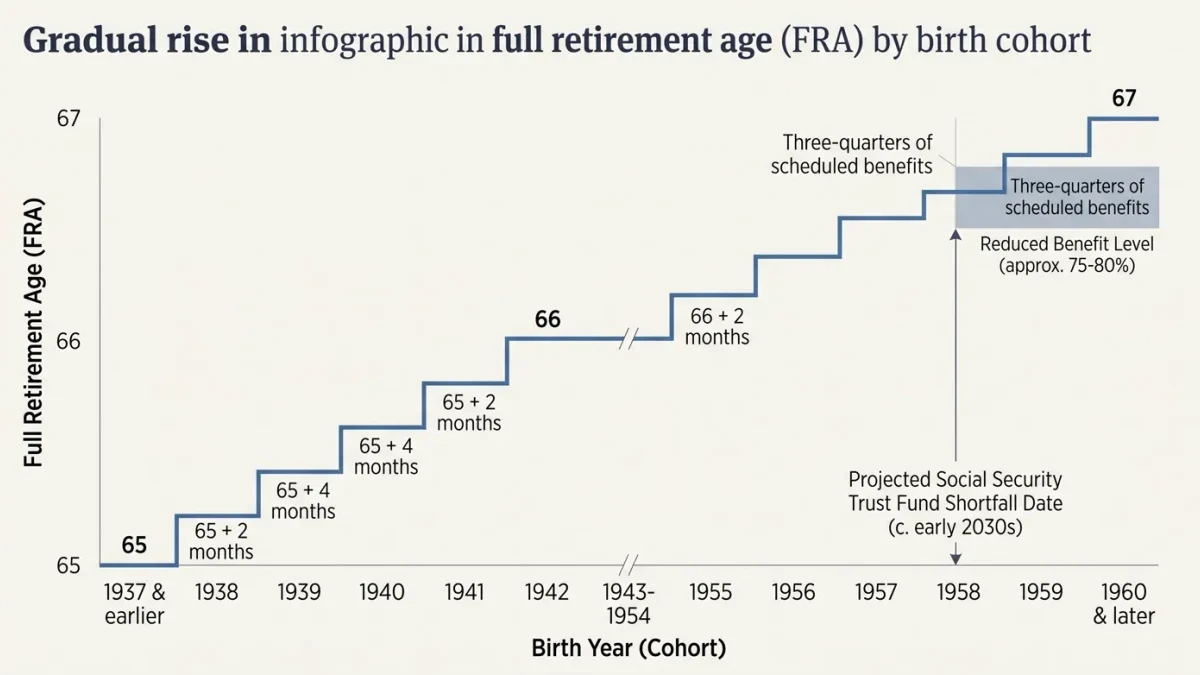
The documented reasons stack, and money leads. The Employee Benefit Research Institute's retirement-confidence surveys document persistent gaps between savings and confidence, with roughly half of workers expressing doubt their money will last, and structural shifts, the decline of private pensions to roughly a tenth of the private workforce, the shift of risk onto 401(k) balances individuals must manage alone, mean retirement income now depends on market timing in a way the previous generation's annuity checks did not. Social Security's full retirement age and the indexing of benefits matter too: delaying claims to 70 raises monthly checks by roughly eight percent per year of delay, an actuarial fact financial planners now preach and labor supply reflects. But the surveys consistently document non-financial motives as well: meaning, structure, and social connection, with a large share of older workers saying they would keep some work even if money were no object.
Where do older workers actually work?
The occupational pattern is documented and specific. Older workers cluster in professional services, where experience compounds, accounting, law, consulting, medicine; in education, from substitute teaching, whose shortages districts fill with returners, to para-professional roles; and in the low-wage service economy, retail, food service, personal care, where the aging of the workforce tracks the aging of the population. The fastest documented growth is in gig and part-time platforms, whose flexibility fits the phased-retirement preference, and whose lack of benefits the previous analysis in this series documented as the trade.
What does age discrimination look like on the record?
The federal Age Discrimination in Employment Act protects workers 40 and older, and the enforcement record documents the gap between protection and practice. EEOC charge data shows age discrimination complaints running steadily, with stronger documentation in tech, where layoffs and restructurings have repeatedly produced settlements and, in one large case, a class resolution over ads and targeting. Research on hiring, resume-correspondence studies that varied only perceived age, documents fewer callbacks for older applicants, particularly in tech and particularly for women. And the 2009 Supreme Court ruling that raised plaintiffs' proof burden made individual suits harder, a doctrinal constraint legal scholars document and Congress has repeatedly failed to legislate around.
What are employers doing about it?
The smartest documented corporate responses treat longevity as a planning variable: phased retirement and consulting-returner arrangements that keep institutional knowledge; retraining benefits aimed at mid-career and later workers rather than only early-career recruits; and ergonomic and schedule redesign in physically demanding roles, where the aging warehouse and construction workforce has driven documented changes in equipment and shift structures. Several large employers in retail and hospitality now recruit explicitly to 55-plus audiences, staffing channels their younger-pipeline competitors ignore.
What does the demographic arithmetic force?
The dependency math: the 65-plus population will grow by tens of millions over the coming decades while the working-age population barely grows, a Census projection that makes older workers' participation a fiscal variable, more workers past 65 mean more payroll tax and output, and the entitlement projections move with the participation rate. The policy levers documented on the menu: expanded phased-retirement rules in federal and private pensions, catch-up training funding, caregiver supports that keep older women, whose participation dips with spousal care demands, attached to work. The retirement at 65 was a mid-century invention; the record documents its reinvention, by necessity and by choice, into something longer and more flexible, one shifted schedule at a time.